The ocean is under pressure
What the latest UN report tells us.
 Every year, scientists publish new numbers about the state of our oceans. More plastic. More pollution. More species under pressure. It can sometimes feel like just another report. But every few years, something bigger happens.
The United Nations brings together hundreds of scientists from around the world to assess the overall health of our oceans. The result is the World Ocean Assessment, one of the most comprehensive reviews of ocean science available today.
The third edition, released this June, paints a clear picture: our oceans are under severe stress.
A growing pressure on the ocean
The report combines research from nearly 600 scientists across 86 countries. It examines everything from biodiversity and fisheries to climate change, pollution and coastal ecosystems. Its conclusion is difficult to ignore.
The ocean continues to absorb the consequences of human activity at a scale never seen before. Rising temperatures, acidification, habitat loss, overfishing and pollution are putting increasing pressure on marine ecosystems. Plastic pollution remains one of the most visible signs of this pressure.
According to the report, millions of tonnes of plastic continue to enter the marine environment every year. Once there, it does not simply disappear. Larger pieces break down into smaller fragments, eventually becoming microplastics that can be found throughout the ocean from coastal waters to the deep sea. Scientists estimate that trillions of microplastic particles are now circulating through marine ecosystems.
The problem is bigger than litter
When people think about plastic pollution, they often picture a plastic bottle floating at sea or washed up on a beach. But the real impact goes much deeper. Plastic affects marine life in many different ways. Animals become entangled in larger debris. Birds, fish and marine mammals mistake plastic for food. Tiny plastic particles can enter food webs and travel through entire ecosystems.
What makes the challenge particularly complex is that plastic pollution is connected to many other environmental issues. Climate change influences ocean currents and extreme weather events, affecting how plastic moves through the environment. Coastal development alters habitats that would otherwise help capture and process waste. Changes in ecosystems can make species more vulnerable to pollution.
In other words: plastic pollution is not an isolated problem. It is part of a much larger story about how we interact with the ocean.
Why data matters

One of the strongest messages in the report is the importance of monitoring and research. Scientists can only understand a problem if they can measure it.
That sounds obvious, but gathering data from the ocean is surprisingly difficult. The ocean covers more than 70% of our planet, and many regions remain poorly monitored. Understanding where plastic ends up, how it moves and what impacts it has requires thousands of observations collected over many years.
This is where citizen science plays an increasingly important role. Researchers alone cannot collect all the information needed to understand a global challenge. By involving communities, volunteers and organisations around the world, much more data becomes available. Every observation helps build a clearer picture.
Seeing the problem with your own eyes
At The Ocean Movement, we believe that change starts with experience. Many people know that plastic pollution exists. Fewer people have had the opportunity to investigate it themselves.
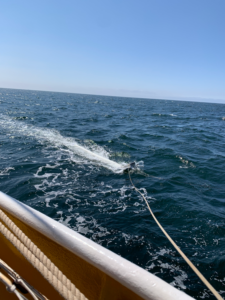
During our sailing expeditions, participants collect samples, contribute to research and learn how scientists study marine plastic pollution in practice. Instead of reading about the problem from a distance, they experience it firsthand. Something remarkable often happens.
What starts as a scientific exercise quickly becomes personal. Participants begin to see the connection between daily choices, waste systems, consumer products and the health of the ocean. The issue becomes real. And when people understand a problem more deeply, they are more likely to become part of the solution.
A reason for concern and a reason for hope
The latest UN assessment is not an optimistic report. It confirms that many pressures on the ocean are increasing and that action is urgently needed. But it also highlights something important: we know more than ever before about what is happening beneath the surface. Knowledge creates opportunities. Every research project, every observation and every person who learns more about the ocean contributes to a growing understanding of the challenge we face.
The ocean’s future will depend on the choices we make today. And those choices begin with awareness, curiosity and a willingness to look a little closer. Because protecting the ocean starts with understanding it.

Plastic pollution reaches the deep-sea…
A new study shows that microplastics have now reached one of the most extreme and isolated environments on Earth: deep-sea hydrothermal vents, more than 2,000 metres below the surface.
Read story

Share this post: