Land, not ocean, is the main source
Are we overestimating airborne microplastics?
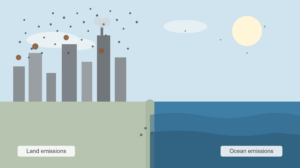 Microplastics are found everywhere: in our oceans, our food, and even the air we breathe. But how much plastic is actually floating around above our heads? A new study suggests that scientists may have been overestimating this for years and that the ocean isn’t the main source of the problem after all.
Researchers from the Department of Meteorology and Geophysics at the University of Vienna compiled 2,782 individual measurements of atmospheric microplastics from studies conducted around the world, and compared them with the transport models scientists have long relied on to estimate how much plastic drifts through the atmosphere. The result was striking: the models overestimated real-world concentrations by a factor of 100 to as much as 10,000.
Land, not ocean, is the main source
For years, the ocean was widely assumed to be a major source of airborne microplastics, with sea spray lifting particles into the air. This new research challenges that view. According to the study, more than 20 times as many microplastic particles are emitted into the atmosphere from land-based sources than from the ocean. Measurements taken over land showed on average 27 times more microplastics than those taken over the sea.
Lead author Andreas Stohl explains that although far fewer particles come from the ocean, the mass of oceanic particles is actually higher, because ocean-emitted particles tend to be larger on average.
Interestingly, the researchers also found that the ocean behaves more like a sink than a source: it contributes only around 0.008% of global atmospheric microplastic emissions, yet accounts for roughly 15% of total deposition — meaning the ocean absorbs far more airborne plastic than it releases.
Why this matters
Airborne microplastics can travel to even the most remote corners of the planet, and can be inhaled by humans and animals or settle into oceans and soils worldwide [1]. Better emission estimates matter because they shape where research, monitoring, and pollution-reduction efforts should be focused. If land — not the sea — is the dominant source, then tackling airborne microplastic pollution may require a stronger focus on urban areas, agriculture, tyre wear, and textile fibres, rather than ocean-based sources alone.
The researchers stress that more data is still needed, particularly on the size distribution of particles, since this remains one of the biggest sources of uncertainty in current models [2][4].
The takeaway
This study doesn’t mean microplastic pollution is any less of a concern: it means our understanding of where it comes from is becoming more precise. And more precise data means more effective action.
Sources
- Microplastics in the atmosphere: higher emissions from land areas than from the ocean
- Land Emits 20 Times More Airborne Microplastics Than Oceans, University of Vienna Study Finds
- Er zweven misschien veel minder microplastics door de lucht dan gedacht
- Microplastics in the atmosphere: Higher emissions come from land areas than from the ocean, study finds
- (PDF) Atmospheric microplastic emissions from land and ocean

Plastic pollution reaches the deep-sea…
A new study shows that microplastics have now reached one of the most extreme and isolated environments on Earth: deep-sea hydrothermal vents, more than 2,000 metres below the surface.
Read story

Share this post: